

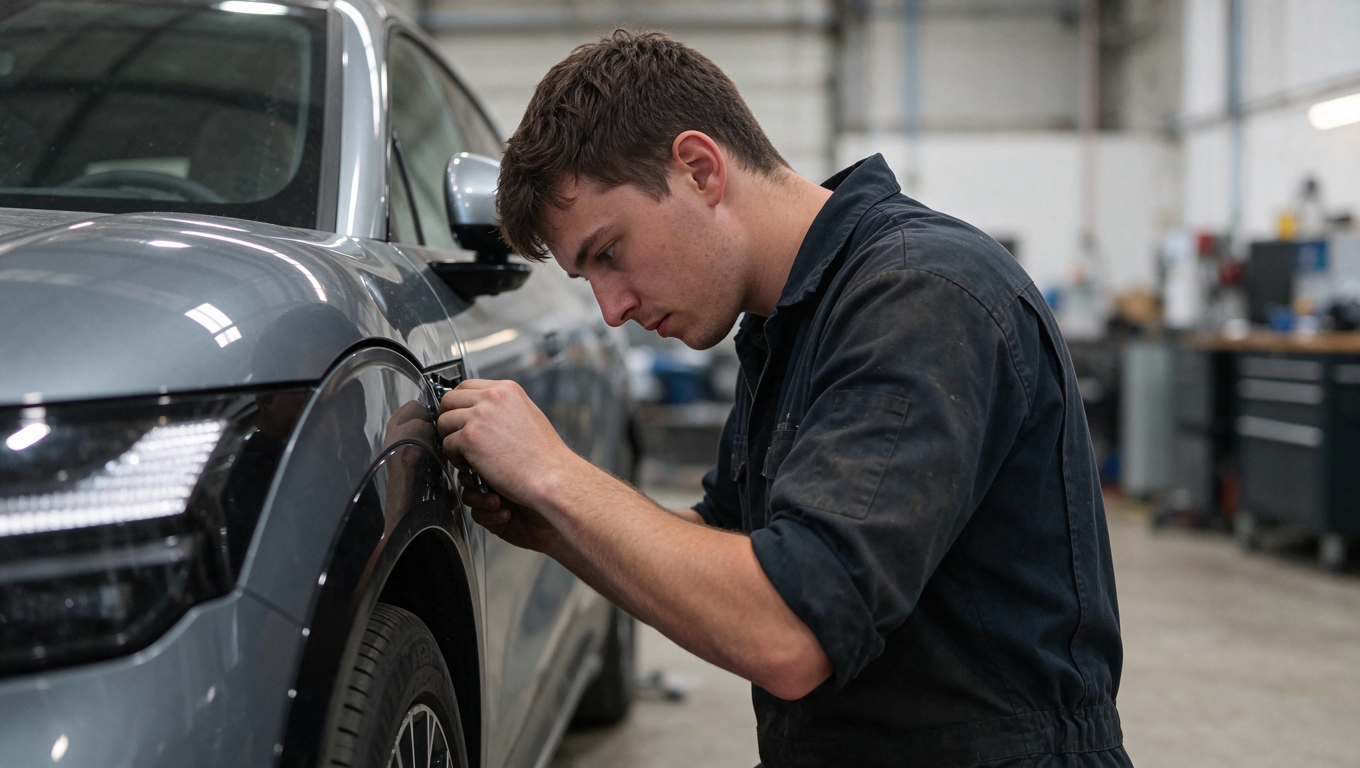
Ask most people what a panel beater does and they’ll say something like “fixes dents and paints cars”. Fair enough. For decades, that was the job.
A Zeekr still needs dents fixed and panels painted. But it also has a high-voltage battery under the floor, power electronics running through it, and a network of cameras and radar that have to be lined up just right. That’s what makes EV collision repair a different kind of job, and not every workshop is set up for it.
Start with the high voltage
Every Zeekr sold here is fully electric. The X, the 7X, the 009, all of them. The 7X runs an 800V system.
Before a technician cuts, welds or pulls on an EV, someone has to check the high-voltage system and, where needed, isolate it. Get that wrong and the technician is at risk, and possibly the car as well. Doing it properly takes training, insulated tools and the right protective gear.
A good EV repairer also thinks a few steps ahead. Welding near cabling and using heat close to the battery get planned for before the job starts, not discovered halfway through.
The damage that hides underneath
A Zeekr’s battery sits low, spread across the floor of the car. Brilliant for handling and cabin space. Less brilliant when you clip a kerb hard or hit debris on the Southern Expressway, because the battery casing or cooling system can take a knock without leaving a mark on the bodywork.
That’s why proper EV collision repair goes deeper than the panels. Any decent EV repairer should:
- inspect the underbody and battery protection for impact damage
- check the high-voltage and cooling systems for faults
- run diagnostics to pick up stored error codes
- flag whether the battery needs a closer look from the manufacturer
Skip those checks and you could drive away with a problem that only shows up months later. Our post on hidden damage after a minor collision explains why a quick look over the car misses so much.
Cameras and radar don’t fix themselves
Zeekrs lean heavily on driver assistance tech. Emergency braking, lane keeping, blind spot monitoring, adaptive cruise. The sensors behind all of it sit in bumpers, grilles, mirrors and windscreens.
Which, annoyingly, are also the parts most likely to get damaged. (If you drive a 7X, we’ve broken down where the Zeekr 7X usually takes the damage in a crash.) So after almost any front or rear repair, those sensors need recalibrating to the manufacturer’s specs. Rush it, and your car might brake for a shadow. Or not brake at all. If you want the longer version, read our guide to sensor calibration after a crash.
Five stars only counts if the repair keeps them
The Zeekr X and 7X both hold 5-star ANCAP ratings. That score comes from the body structure absorbing and spreading crash energy the way it was designed to.
Use the wrong materials, the wrong joining method or cheap aftermarket panels, and the car can look perfect while behaving differently in the next crash. It can drag down resale value too. We cover that in will your car be worth less after a collision repair?
The finish still matters
People who buy a Zeekr notice details. Uneven panel gaps, or a bumper that’s half a shade off, will bug them every time they walk up to the car. A specialist matches paint to factory colour standards and follows the manufacturer’s guidance on refinishing EVs, which can include keeping heat in check around the battery and electronics.
Questions worth asking before you book
- Are your technicians trained to work on high-voltage EVs?
- How do you make the high-voltage system safe before starting?
- Will you check the battery and underbody for hidden damage?
- Do you follow manufacturer repair procedures and use genuine parts?
- Can you recalibrate ADAS sensors in-house?
- How long is your work guaranteed?
And remember, with most comprehensive policies the choice of repairer is yours, not your insurer’s. Here’s what the law says in South Australia.
Where Eblens fits in
We’ve been repairing cars in Adelaide for more than 40 years. These days, a lot of that work is on the most advanced vehicles on the road.
Our whole team is I-CAR Platinum certified, we run EV-safe repair processes, and we’re part of the Tesla Approved Body Shop Network. That EV experience goes into every Zeekr that comes through our doors in Somerton Park.
Find out more about our Zeekr repairs in Adelaide and our electric vehicle repairs, or give us a call on 08 8294 2952.
EV collision repair FAQs
Why is EV collision repair different?
Zeekrs are fully electric, with high-voltage systems, a battery pack in the floor and camera and radar safety systems. Repairing them safely takes EV training, high-voltage safety procedures, manufacturer repair methods and ADAS calibration equipment.
Can a minor crash damage a Zeekr’s battery?
It can. A hard impact, a mounted kerb or road debris can damage the battery’s protective casing or cooling system without any obvious damage on the outside. That’s why EV repairs should include an underbody and battery inspection.
Do Zeekr repairs need genuine parts?
Genuine parts are designed to fit and perform exactly as the manufacturer intended, which helps keep the car’s structure, safety systems and resale value intact.
What is high-voltage isolation?
It’s the process of making an EV’s high-voltage system safe before repairs begin, so technicians can work on the car without electrical risk.
How do I know if my EV’s battery was damaged in a crash?
You often can’t tell by looking. Warning lights, a burning or chemical smell, or any hit to the underbody are signs to stop driving and get it checked. A repairer with EV training can inspect the battery casing, cooling system and diagnostics to confirm whether there’s damage.